_
Category: Architecture in general
-

The Modern Enterprise Architect
Post date:
There was a time when the Enterprise Architect was easy to identify. They were the ones with the largest diagrams. The most boxes and arrows. The most opinions about standards. They could quote frameworks like scripture and had a sixth sense for spotting an unauthorized integration. If something wasn’t aligned to the target architecture, they…
-
Creating Enterprise and Architecture Principles
Post date:
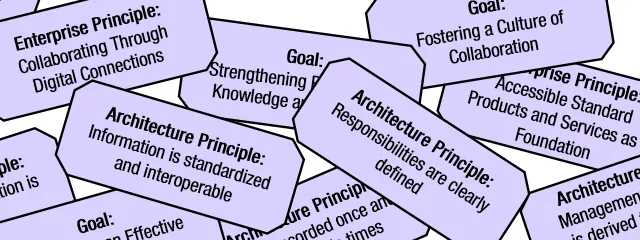
Within an Enterprise Architecture approach, principles serve as a foundation for designing flexible and scalable architectures that align with business goals and objectives. They ensure compliance with regulations and industry standards and are able to reduce complexity and duplication by enforcing standardization and interoperability. Principles provide clarity, consistency, and direction in decision-making, ensuring alignment between…
-
Let’s Talk Enterprise Architecture
Post date:
If you want to start an Enterprise Architecture conversation properly, the best move is to begin by agreeing on language before agreeing on solutions. Terminology is never a trivial preface — it is part of the architecture itself. Words define boundaries, and boundaries determine decisions. A surprising number of failed architecture initiatives do not collapse…
-
More Practicality, Less Theory
Post date:
Enterprise Architecture frameworks are rarely questioned at the conceptual level. Most architects accept their value. Many organizations reference them explicitly. Certifications remain popular, methods are well known, and the language of architecture has become increasingly standardized across the profession. Yet something interesting happens when these frameworks enter daily practice: the translation becomes challenging, resulting in…
-
Starting Your Career in EA
Post date:
Embarking on a career in Enterprise Architecture can feel a bit like being handed a map of a city you’ve never visited, and being told that every street, alley, and café is critical. You're then asked to solve a mystery. To put it in simple terms: starting your career in EA can be a challenge!…
-
Risk Management (2/2)
Post date:
The Architecture Development Method (ADM) of the TOGAF Standard describes a number of techniques a practitioner has at his disposal. Risk Management is the second-to-last technique that is described. Since it is addressed in several phases (Phase A and Phases E through H), it can be seen as an integral part of architecture development. Applying…
-
Risk Management (1/2)
Post date:
The Architecture Development Method (ADM) of the TOGAF Standard describes a number of techniques a practitioner has at his disposal. Risk Management is the second-to-last technique that is described. Since it is addressed in several phases (Phase A and Phases E through H), it can be seen as an integral part of architecture development. Applying…