_
Tag: principles
-

More Practicality, Less Theory
Post date:
Enterprise Architecture frameworks are rarely questioned at the conceptual level. Most architects accept their value. Many organizations reference them explicitly. Certifications remain popular, methods are well known, and the language of architecture has become increasingly standardized across the profession. Yet something interesting happens when these frameworks enter daily practice: the translation becomes challenging, resulting in…
-
A Scrapbook of Past Projects
Post date:
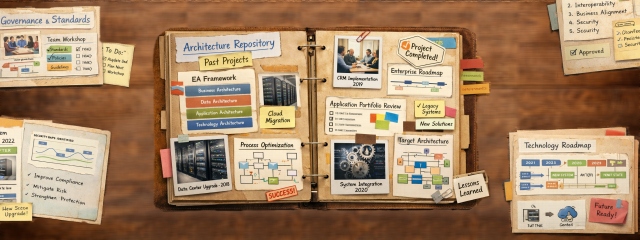
Enterprise Architecture has a reputation problem. Not because it lacks rigor or structure — quite the opposite. But because too often, architecture feels like something that exists next to the organization rather than within it. Diagrams live in tools, standards sit in documents, and architectural knowledge slowly fragments across folders, platforms, and people’s heads. It's…
-
Architecture Beyond Domains
Post date:
Enterprise Architecture has been around for decades. The discipline has profoundly shaped how organizations plan, align, and structure their strategies, systems, and operations. Frameworks such as the TOGAF Standard define four architecture domains and link them to specific architectural roles. While this approach has helped organizations organize work, it has also unintentionally reinforced rigid silos…
-
Architecting with AI
Post date:
Artificial Intelligence is often portrayed as a disruptive force — one that demands new methods, tools, and frameworks. But in practice, AI doesn’t replace traditional architecture frameworks. Instead, it enhances them. This is especially true when it comes to the TOGAF Standard’s Architecture Development Method (ADM). Rather than rewriting the playbook, AI can act as
-
Enterprise Architecture Rises In The East
Post date:
Enterprise Architecture is more than just a methodology—it's a strategic powerhouse driving alignment between business objectives and technology. In China, where rapid economic growth meets technological innovation, Enterprise Architecture has emerged as a critical enabler. The country's enterprises, ranging from state-owned giants to tech startups, are leveraging Enterprise Architecture to address unique challenges: scalability, digital…
-
Agile Architecture Agony
Post date:
In recent years, the agile way of working has become popular because it promises to make things more flexible, faster, and better at handling changes. However, when it comes to Enterprise Architecture, using agile methods can be tricky. It might cause problems, leading up to agile architecture agony. Agile methods are great for short, simple…
-
Globally Scaled Architecture
Post date:
In the fast-paced landscape of global trade, the Port of Rotterdam stands as a beacon of efficiency and innovation. As Europe's largest seaport (handling close to 9 million containers annually), it serves as a vital gateway for the movement of goods between continents. Behind its towering cranes and bustling terminals lies a meticulously designed framework…