_
Tag: architecture domains
-

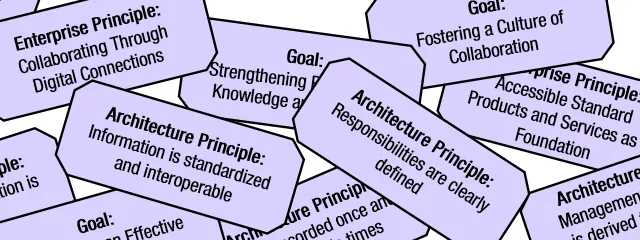
Creating Enterprise and Architecture Principles
Post date:
Within an Enterprise Architecture approach, principles serve as a foundation for designing flexible and scalable architectures that align with business goals and objectives. They ensure compliance with regulations and industry standards and are able to reduce complexity and duplication by enforcing standardization and interoperability. Principles provide clarity, consistency, and direction in decision-making, ensuring alignment between…
-
Architecture Beyond Domains
Post date:
Enterprise Architecture has been around for decades. The discipline has profoundly shaped how organizations plan, align, and structure their strategies, systems, and operations. Frameworks such as the TOGAF Standard define four architecture domains and link them to specific architectural roles. While this approach has helped organizations organize work, it has also unintentionally reinforced rigid silos…
-
Mythbusting the TOGAF Standard
Post date:
I have said it before: the TOGAF Standard is awesome. If you make an effort to really understand the framework you will agree with me. Unfortunately, despite being around for thirty years, it is still often rigorously misunderstood and misinterpreted. And it is these misinterpretations that lead to the myths that circle the framework. That…
-
The Misplaced Enterprise Architect
Post date:
The role of the Enterprise Architect is misplaced in many organizations. In nine out of ten cases, the Enterprise Architect is portrayed as an IT Architect. This misalignment has significant consequences for an organization. The primary role of the Enterprise Architect is to help an organization achieve its goals.
-
The TOGAF Standard Is Awesome
Post date:
We are probably all familiar with the TOGAF® Standard. Or just TOGAF, for friends and foes. An Enterprise Architecture framework pur sang and a very complete one if you ask me. The framework covers all aspects of Enterprise Architecture and allows for all kinds of tailoring. This makes it an excellent framework for any architecture…
-
Organizational Architecture Hierarchy
Post date:
There is some form of hierarchy in every organization. It is almost a necessity. And while many organizations try to make the distance between the layers of the organizational hierarchy as transparent and as small as possible, few really succeed. Nevertheless, hierarchy is simply necessary for good business. The same is true in the field…
-
If AI Decided On ArchiMate Elements
Post date:
What would happen if AI decided on ArchiMate® elements; on the colors and icons (or symbols) of the modeling language? Nowadays, a question like this is easily answered. But before discussing how Artificial Intelligence responded to this question, let's look at where the original colors came from and how they came to be.