


Within an Enterprise Architecture approach, principles serve as a foundation for designing flexible and scalable architectures that align with business goals and objectives. They ensure compliance with regulations and industry standards and are able to reduce complexity and duplication by enforcing standardization and interoperability.
Principles provide clarity, consistency, and direction in decision-making, ensuring alignment between business objectives and strategies. Evidently, their value lies in ensuring that business and IT strategies support the same objectives. In other words, principles guide strategic alignment. They also allow for standardizing approaches across different teams, reducing conflicts and inefficiencies. Principles enable better decision-making by providing a structured framework to evaluate options and trade-offs. They help establish clear policies and accountability in architecture development. Last but not least, principles ensure a shared understanding of organization and architecture goals and objectives.
This hands-on blog will focus on creating Enterprise and Architecture Principles, based on an organizational strategy.
What are Enterprise and Architecture Principles
Before diving into the practical approach, let’s first look at what principles are and how they should be interpreted.
There are two types of principles: Enterprise Principles and Architecture Principles. The two may seem similar, but there is a distinct difference between them, as they each serve different purposes.
- Enterprise Principles. High-level, general guidelines that shape the overall strategy, culture, and decision-making framework of an organization. These principles apply broadly across the entire organization, influencing business operations, IT strategy, and governance. They typically address aspects such as business agility, innovation, customer focus, security, compliance, and sustainability.
- Architecture Principles. More specific guidelines that direct the design and development of Enterprise Architecture. They apply to architecture development efforts, ensuring consistency, scalability, and alignment with business goals. These principles provide direction for technology choices, system integration, and IT governance.
Enterprise Principles provide a basis for decision-making throughout an enterprise and inform how the organization sets about fulfilling its mission. Architecture Principles are a set of principles that relate to architecture work.1
The key differences between Enterprise and Architecture Principles are outlined in the table below.
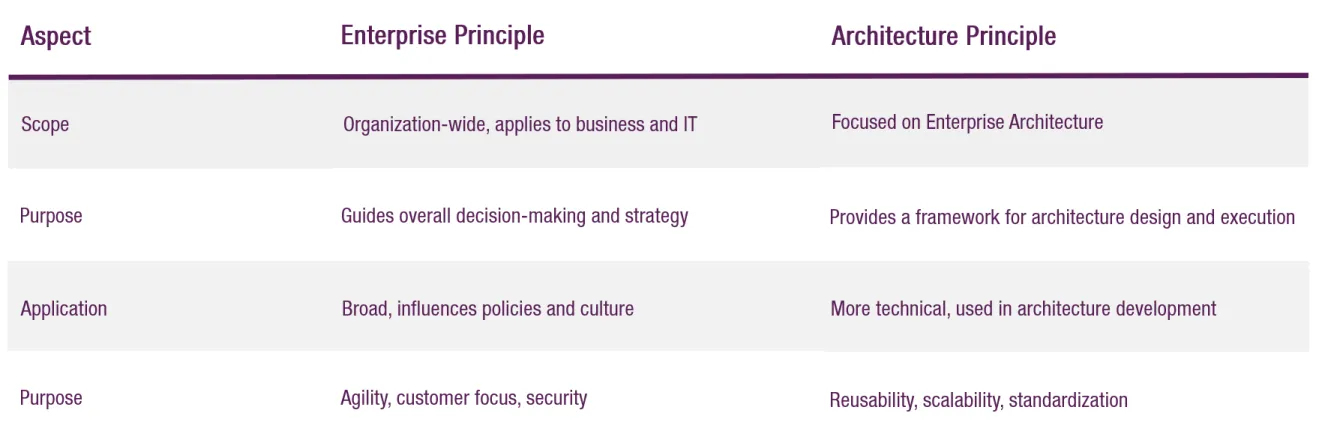
Architecture Principles build on what has been established at a higher level, by Enterprise Principles. In a way, Enterprise Principles define the boundaries for the Architecture Principles.
The approach
I recently started working for an organization that is relatively new to architecture. It required — and still requires — a lot of work to reach a point where the foundation began to take shape. One of the many tasks I undertook was translating the organization’s strategy into principles. The organization wanted to improve its control over the implementation of projects and initiatives in line with its strategic direction. There are many ways to accomplish this, of course. One way is by applying Enterprise and Architecture Principles.
The approach I used is as follows.
From goals to guidelines
First, I examined the organization’s strategy, focusing specifically on its goals. The strategy provided a description of what each goal means.
I highlighted the key keywords or parts of sentences that captured the essence of each goal. An example of this can be seen in the image below. Next, I translated the highlighted phrases into potential guidelines that could be used to achieve the goals. This resulted in a set of guidelines for each goal that justify a potential approach. The justifications are shown in the last column of the image below. They formed the basis for what would later become Enterprise Principles.
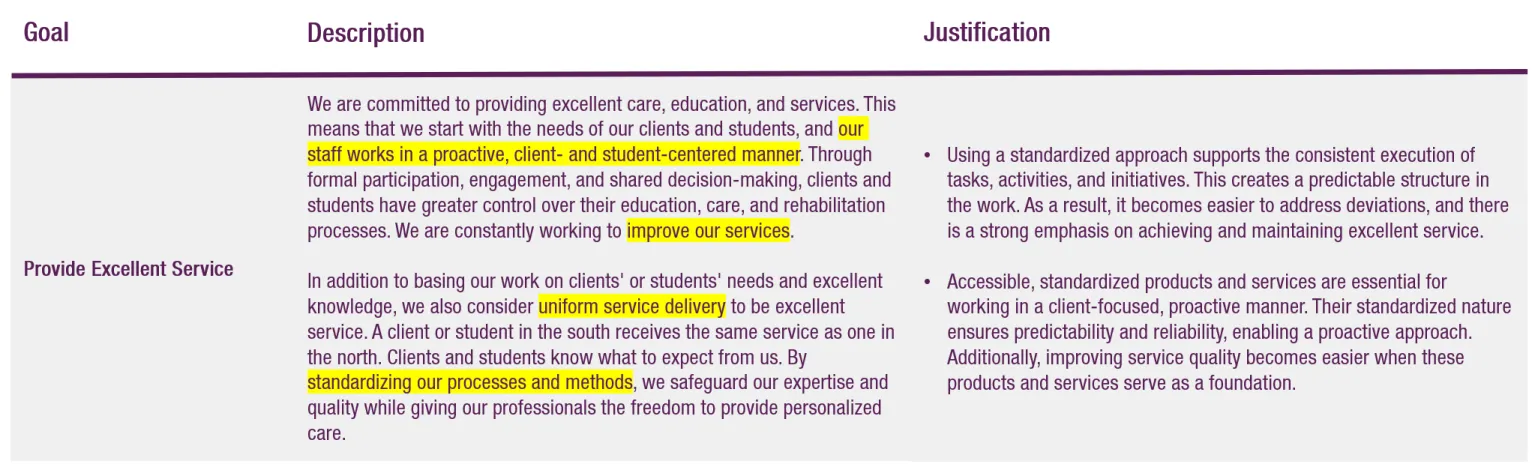
I carried out this activity for each goal, which gave me a clear overview of the various guidelines aligned with them. I ensured that the strategy continued to be reflected in the wording of the Enterprise Principles by asking the AI to use all these guidelines to help formulate them. The prompt I used is shown below.
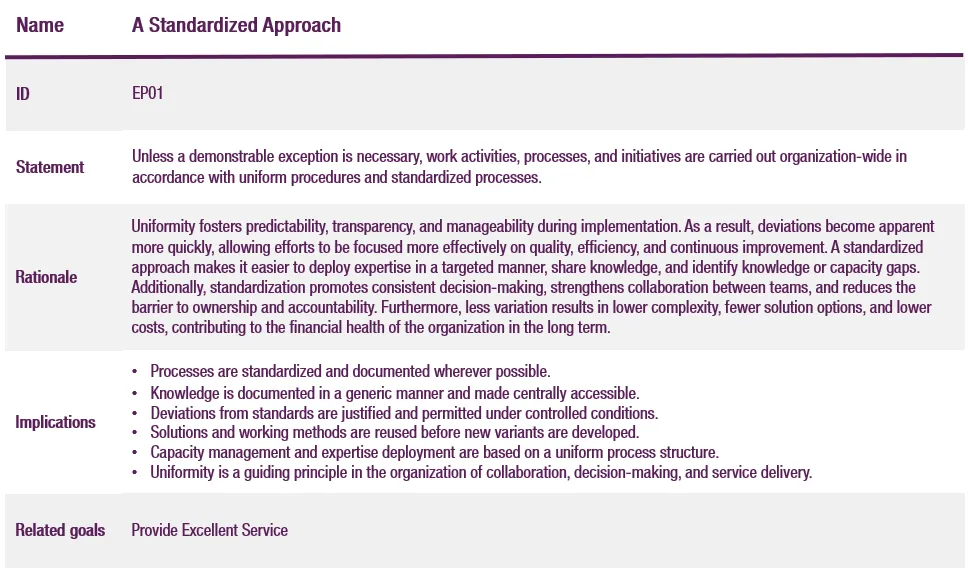
Can you summarize the following guidelines and transform it into an Enterprise Principle? Keep the TOGAF Standard’s definition for Enterprise Principles in mind when making a suggestion.AI effortlessly generated Enterprise Principles based on the guidelines I created. An example of an Enterprise Principle generated by AI is shown below.
Creating Architecture Principles
Next, I formulated Architecture Principles based on Enterprise Principles with the help of AI. I used all the Enterprise Principles to define Architecture Principles across the four architecture domains: Business, Information/Data, Application, and Technology. The goal was to generate a relatively small number of Architecture Principles to maintain a clear overview. I chose three or four principles per architecture domain. Guided by the Enterprise Principles, the Architecture Principles remained aligned with the organizational strategy.
The prompt I used looked as follows.
Enterprise Principles are high-level, generic guidelines related to an organization's strategy, culture, and decision-making body. Architecture Principles guide the architecture development process and direct the application of Enterprise Principles, from which they are derived.
Can you formulate an average of three Architecture Principles for each domain (Business, Information/Data, Applications, and Technology)? Adhere to the TOGAF Standard when doing so.
The AI engine generated a clear overview of three Architecture Principles for each domain with ease. See the example below.
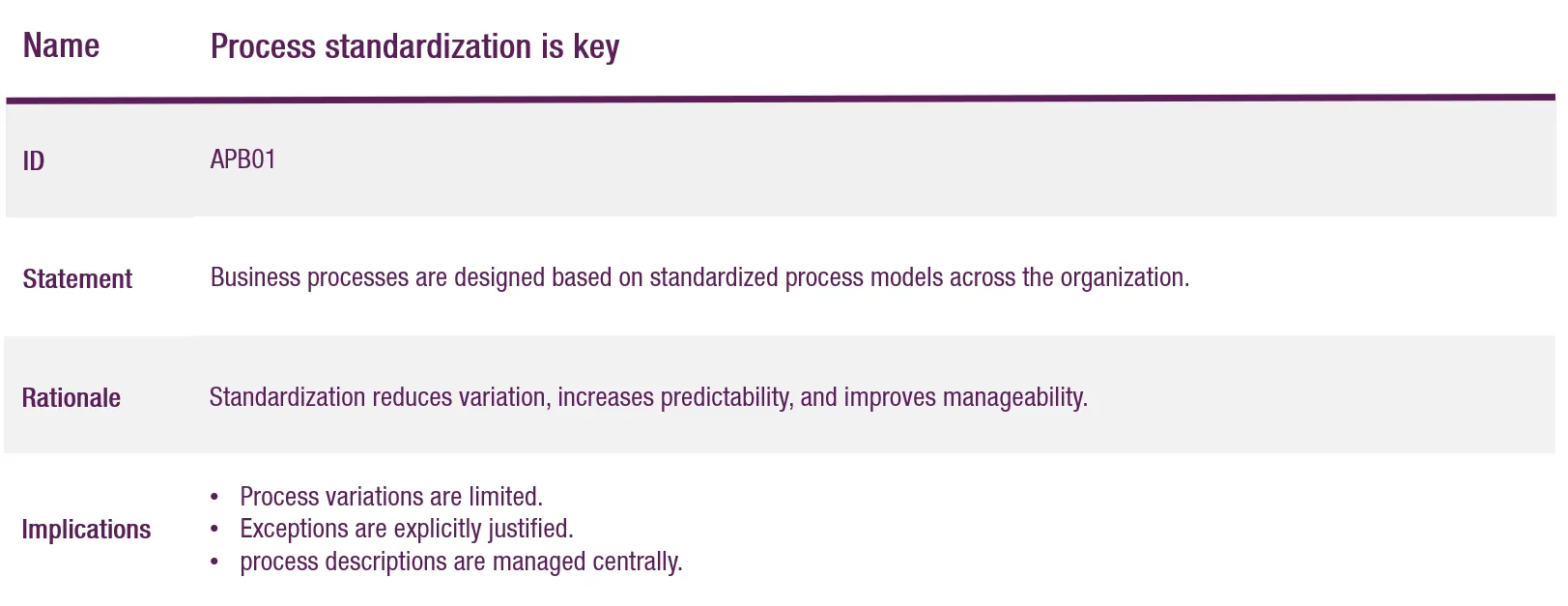
The focus on standardization is what stands out in the example of the Architecture Principle. This creates a direct link to the overarching Enterprise Principle, “A Standardized Approach“. It also illustrates the connection to the goal “Provide Excellent Service“, as one of the associated guidelines states: “Using a standardized approach supports the consistent execution of tasks, activities, and initiatives.“
Mapping Enterprise and Architecture Principles
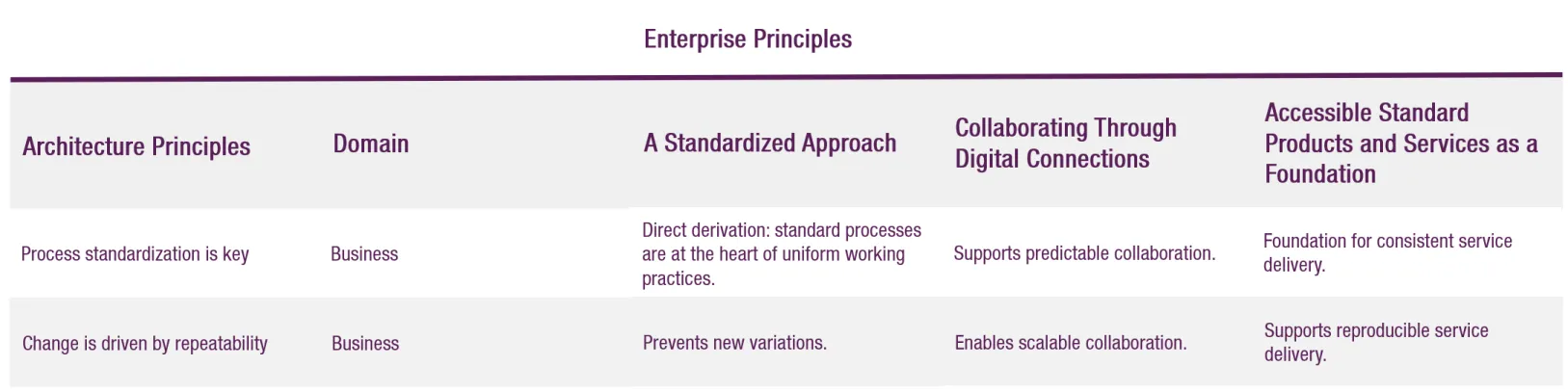
One of the final steps I took was mapping the Architecture Principles to the Enterprise Principles to show their relationships. This mapping shows that each Architecture Principle relates to each Enterprise Principle. The mapping below only shows a subset of the total number of principles.
Visualizing the principles
After completing the above steps, I created an ArchiMate diagram illustrating the organization’s goals, Enterprise Principles, and Architecture Principles.
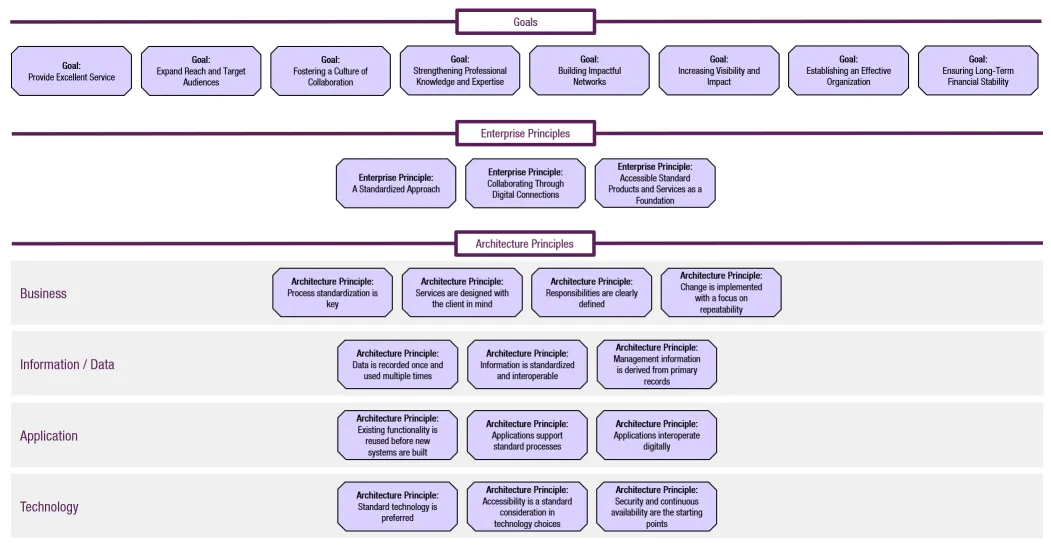
I was able to easily visualize how the various principles related to one another and to the goals outlined in the strategy using color-coded views. With this view, I convinced the Board of Directors of the value and necessity of adopting and applying Enterprise and Architecture Principles.
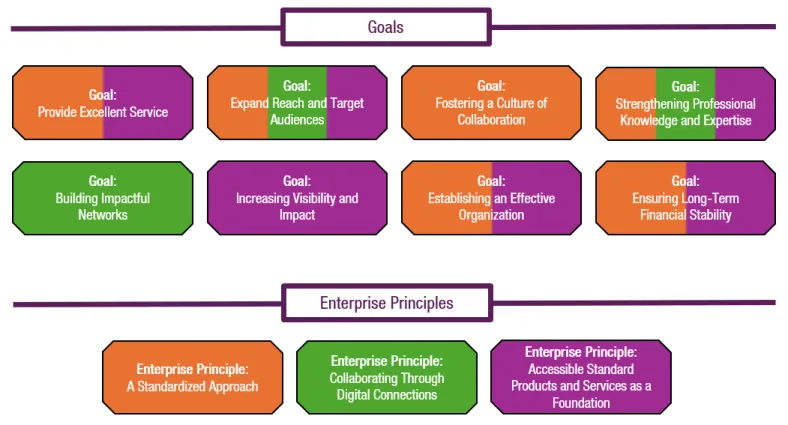
Goals mapped to Enterprise Principles (color view)
The Board of Directors has now formally approved these principles, and projects and initiatives are being designed and implemented in accordance with them. This helps the organization maintain control over project implementation in line with its strategic direction.
Summing up the approach
Enterprise Architecture is about bringing order, clarity, and direction to how an organization grows and evolves. Principles play a central role in this: they act as a foundation for building architectures that are not only scalable and flexible, but also tightly aligned with business goals. By enforcing consistency, standardization, and interoperability, principles help reduce complexity and avoid duplication across teams and systems. More importantly, they create a shared language for decision-making – ensuring that both business and IT are pulling in the same direction while staying compliant with regulations and industry standards.
In practice, turning strategy into actionable principles doesn’t have to be overwhelming. A structured approach – starting with organizational goals, translating them into clear guidelines, and then shaping those into Enterprise Principles – can make the process surprisingly manageable. From there, more specific Architecture Principles can be derived to guide design decisions across business, data, application, and technology domains. This layered approach not only keeps architecture aligned with strategy but also makes it easier to communicate and visualize across the organization. When done well, it creates a powerful framework that helps leadership maintain control over initiatives, ensures consistency in execution, and ultimately brings strategy to life in a tangible, actionable way.
- The Open Group. The TOGAF® Standard, 10th Edition: Architecture Development Method. ’s-Hertogenbosch: Van Haren Publishing, 2022. ↩︎





Leave a Reply