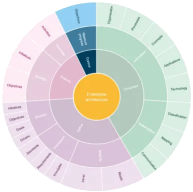
The Enterprise Architecture Implementation Wheel draws its foundation from the TOGAF® Standard. The approach takes TOGAF’s established structure and flow, then streamlines and reorganizes certain elements to make them more accessible. Instead of trying to cover every detail, it creates a practical foundation that helps organizations successfully embrace and put the core principles of the TOGAF Standard into action.
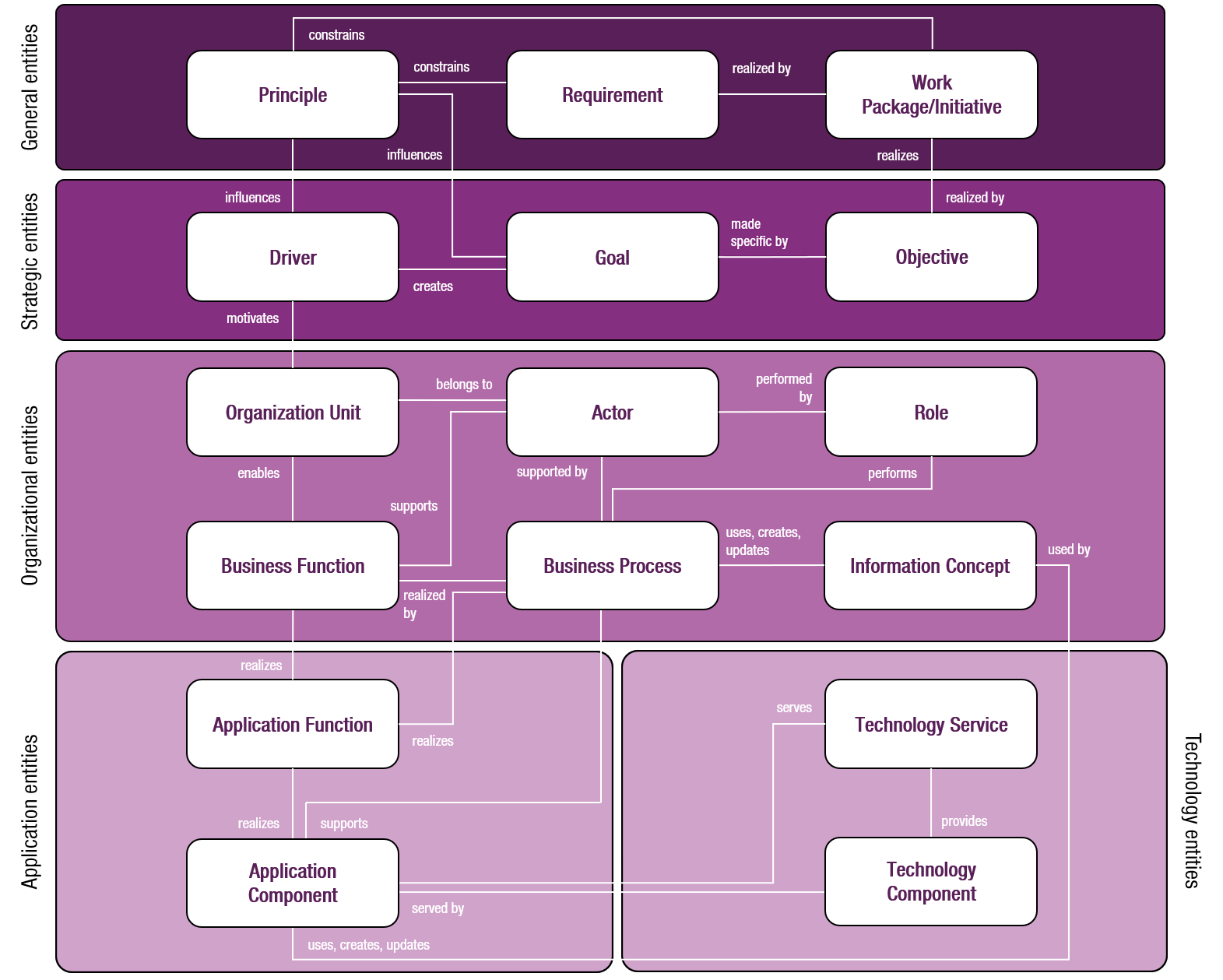
The Implementation Wheel approach emphasizes the fundamentals by utilizing a metamodel that includes the most commonentities and their relationships, reflecting how they typically appear in various organizations.
This metamodel provides the context for the specific artifacts referenced in the Enterprise Architecture Implementation Wheel approach.
The image below is interactive. Click on any of the entities to discover more details about each one.
A large version of the metamodel can be downloaded from the media page.
It focuses on semantically meaningful relationships between entities, rather than simply connecting everything in a layered diagram.
The relationships in the metamodel adhere to the guidelines established by the TOGAF Standard.
Relationships between entities
The entities of the metamodel are structured into five distinct layers.
Generic entities
Strategic entities
Organizational entities
Application entities
Technology entities
Each layer contains multiple entities, and every entity has a relationship with one or more other entities. Click on a tab in the table below to view the relationships between the entities.
Source entity
Relationship
Target entity
Meaning
Principle
constrains
Work Package/Initiative
Initiatives should comply with applicable Principles.
Principle
constrains
Requirement
Requirements should be consistent with applicable Principles.
Principle
influences
Goal
Principles guide decisions about how Goals should be pursued.
Requirement
is realized by
Work Package/Initiative
An Initiative implements a change that satisfies a Requirement.
Work Package/Initiative
realizes
Objective
An Initiative delivers changes that contribute to achieving an Objective.
Note: a Requirement specifies a condition that a solution, capability, or architecture must satisfy.
Source entity
Relationship
Target entity
Meaning
Driver
influences
Principle
A Driver can motivate the establishment or revision of a Principle.
Driver
creates
Goal
A Driver provides the rationale for pursuing a Goal.
Driver
motivates
Organization Unit
A Driver can motivate an Organization Unit to define its Goals and implement the necessary changes to achieve them.
Goal
is influenced by
Principle
Principles guide decisions about how Goals should be pursued.
Goal
is made specific by
Objective
Objectives express specific, measurable outcomes that contribute to a Goal.
Objective
is realized by
Work Package/Initiative
An Initiative delivers changes that contribute to achieving an Objective.
Important distinction: a Goal describes a desired state; an Objective makes the desired outcome more specific and measurable. An Initiative is a coordinated unit of work intended to deliver change.
Source entity
Relationship
Target entity
Meaning
Organization Unit
is motivated by
Driver
An Organization Unit is motivated by a Driver to define goals and implement the necessary changes to achieve them.
Organization Unit
enables
Business Function
An Organization Unit enables and may have accountability for a Business Function.
Actor
belongs to
Organization Unit
An Actor may belong to an Organization Unit.
Role
is performed by
Actor
An Actor is responsible for performing a Role.
Role
performs
Business Process
A Role is responsible for performing or participating in a Business Process.
Business Function
is realized by
Business Process
A Business Process operationalizes or supports a Business Function.
Business Function
supports
Actor
A Business Function is operationalized or supported by an Actor.
Business Function
is realized by
Application Function
An Application Function supports the performance of Business Capabilities or Functions.
Business Process
uses, creates, or updates
Information Concept
A Business Process uses Information Concepts to perform its activities. A Business Process can create, modify, or maintain Information Concepts.
Business Process
is realized by
Application Function
An Application Function supports or automates activities in a Business Process.
Information Concept
is used by
Application Component
An Application Component manages, accesses, or processes information representing the Information Concept.
Note: a Business Function describes what the organization does; a Business Process describes how work is performed. A function is not necessarily realized by only one process, and a process may support multiple functions.
An Actor entity represents the person, group, or organizational entity performing behavior; a Role describes the responsibility or capacity in which it acts. An actor can have multiple roles, and a role can be assigned to multiple actors.
The entity Organization Unit is used to represent formal organizational structure, not as a substitute for an actor or role. An Organization Unit may own a Business Function or Process without performing every activity itself.
The Information Concept represents the business meaning of information, independently of how it is stored technically. For example, Customer, Order, and Invoice are Information Concepts.
Source entity
Relationship
Target entity
Meaning
Application Function
realizes
Business Function
An Application Function supports the performance of Business Capabilities or Functions.
Application Function
realizes
Business Process
An Application Function supports or automates activities in a Business Process.
Application Component
realizes
Application Function
An Application Component provides application behavior through its functions.
Application Component
supports
Business Process
A Business Process is automated or supported by an Application Component.
Application Component
uses, creates or updates
Information Concept
An Application Function reads, creates or modifies an Information Concept.
Application Component
is served by
Technology Component
An Application Component is served by a Technology Component on which it is hosted or deployed.
Note: an Application Component represents a deployable or identifiable application-level structure. An Application Function represents behavior that the component performs. One component can provide multiple functions, and a function may be supported by multiple components.
The Application Component’s relationship with a business process is usually indirect. It is the Application Function that realizes the process. A direct Application Component supports Business Process relationship may be added for simplified stakeholder views, but it should not replace the more precise relationship.
Source entity
Relationship
Target entity
Meaning
Technology Component
provides
Technology Service
A Technology Component provides a technical capability exposed as a service.
Technology Service
serves
Application Component
An Application Component consumes a Technology Service.
Note: A Technology Component represents technology structure, such as a database server or infrastructure component. A Technology Service represents the technical capability made available to its consumers, such as database access, messaging, or identity management. The distinction between the is deployed on and uses a technology service relationship is useful: an application may run on a platform while also consuming services provided by other technology components.